Writing · Personal essay · 05 May 2026
We left Gaza in late December. The war followed us anyway.
A personal account of evacuation, loss, birth in exile, and rebuilding through research.
I left Gaza in late December 2023 believing I might be back in a few weeks.
I told myself the war would probably be over by New Year 2024. It was not.
At that point, we had already been pushed south more than once. We were asked to evacuate Gaza City, so we moved to Khan Younis. Then the ground offensive reached Khan Younis, and we were pushed south again to Rafah.
Every move made your life smaller. Fewer streets you trust. Fewer places to sleep. Fewer assumptions about what tomorrow might look like.
People often ask when I "decided" to leave, as if there was one clear moment, one clean calculation. It was not clean. It was accumulation: pressure, fear, responsibility, and the collapse of basic systems around us.
One of the deepest personal losses in that period was Dr Maisara Alrayyes. He was a medical doctor at Medecins du Monde, and one of my closest friends. We were both Chevening scholars in London in 2019/20 - he studied at KCL, I studied at Imperial - and we stayed close from that time through our years back in Gaza.
Only a few days before October 7, we had gone together to a friend's family funeral in the far north. On the way back, I drove us along Gaza's coastline all the way to his home. It was one of those ordinary drives you do not think to archive because you assume there will be many more.
There were not.
He was killed when his house in Gaza City was flattened.
I still have videos from that coastline ride, with him beside me. Watching them now is difficult in a way that is hard to explain: you are not only grieving a person, you are grieving a full geography of memory. Streets, corners, coastlines, routines, voices - all suddenly archived instead of lived.
Later, during the short truce period in early 2025, we learned our own home had also been destroyed, along with our neighborhood and large surrounding residential areas.
People use the word "destroyed" in headlines every day. Living it is different. Destroyed means your address stops being a place and becomes a before-and-after sentence.
The final reason we left was not political strategy. It was immediate family survival.
My wife was due soon.
In Rafah, we were hearing increasingly horrific stories from people we knew: births under impossible conditions, some without anesthesia, some outside functioning hospital care. Hospitals were being attacked. At that point, the question was no longer "Is evacuation ideal?" It was "Can we safely have this baby if we stay?"
So we moved.
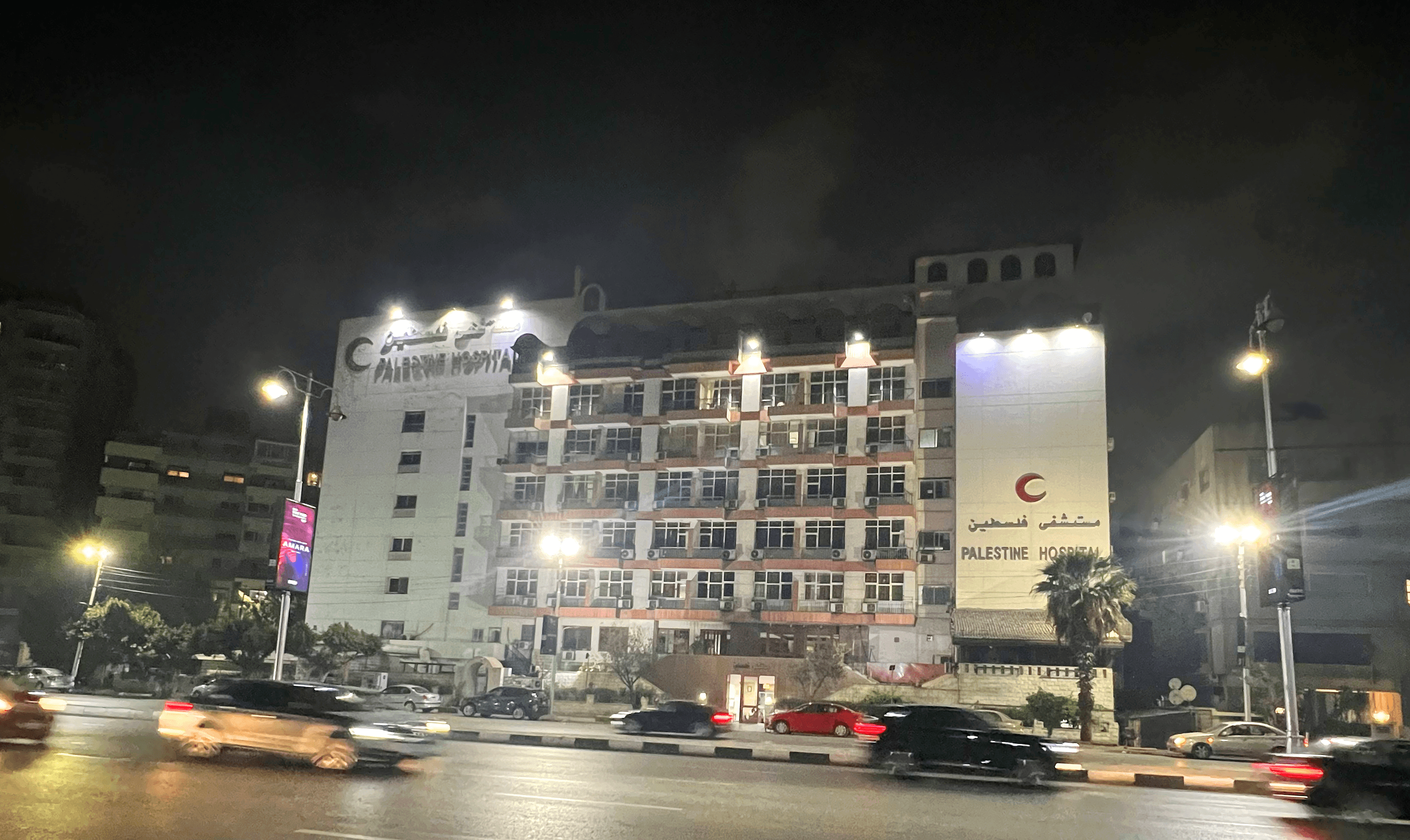
I remember the crossing day less as a sequence and more as an altered state. We started at sunrise and reached Cairo close to midnight. The vehicle that took us from Rafah dropped us opposite Palestine Hospital in Heliopolis.
What I remember most was the soundscape.
No blasts. No immediate fear response. Planes overhead sounding like ordinary traffic noise, not a warning of what is coming next.
It felt deeply strange that only a short distance away, life could be functioning normally while Gaza was being destroyed. The physical distance was small. The lived distance was immense.
In late January 2024, our first child was born in Cairo.
This should have been a simple chapter of joy. It was joy, but it was not simple. We had no close family around us. My mother and siblings were absent. My wife's immediate family were absent too. We were new parents in a new country while both families remained inside a war zone.
Crossing a border did not end the war for us. It changed the shape of it.
In Egypt, the hardest part was distance with uncertainty. Communication would drop for long stretches. Calls often failed. Internet access was unstable. You keep redialing because silence can mean anything.
During that period, I witnessed the loss of family members, cousins, very close friends, neighbors, and colleagues.
People sometimes imagine survival as a clean line: danger, then safety, then recovery. In reality, it is layered. You can be physically safer and emotionally in freefall at the same time.
I was trying to hold two responsibilities at once: protect what remained of my family life, and rebuild a viable professional future from a place that still felt like emergency.
That is when I applied to Cara for a PhD pathway in the UK.
My current four supervisors interviewed me through that process. Their seriousness, generosity, and willingness to invest in my work gave me a form of stability I badly needed. I started my PhD at Newcastle University in March 2025, with Cara sponsorship and a Newcastle fee waiver.
I do not tell this part as a "success story" in the motivational sense. I tell it because rebuilding is also a form of responsibility. It is how you keep faith with people you lost, with people still at risk, and with people whose talent has been constrained by war and displacement.
The dominant image many people have of Gaza is either victimhood or geopolitics. Both are incomplete.
There is extraordinary talent in Gaza: clinicians, engineers, researchers, operators, founders, designers, educators - people who can build, lead, and contribute at the highest levels when given a fair chance.
What is missing is not capability. What is missing is access, structure, and long-term commitment.
If there is one reason I wanted to write this piece, it is this: memory should not end at mourning. It should be converted into pathways.
I am open to working with organizations that can translate solidarity into structured opportunities for Gaza talent across growth, research, and social-impact work.
Over the years, I have trained and mentored affected talent through and alongside programs linked to Mercy Corps, Gaza Sky Geeks, UCASTI, and BTI Gaza. So this invitation is not only about me personally. It is about opening pathways for Gaza talent across almost every discipline. If you are building a strong team, I am happy to connect you with people from Gaza you would be glad to have on it.
That can mean funded research positions, remote paid project roles, fellowships, practical mentorship, or institutional partnerships that are designed to last.
Not symbolic gestures. Not one-off statements. Real opportunities with real continuity.
I left Gaza in late December 2023 believing I would return in weeks.
I am still carrying that interrupted life, but I am also building from it. And I know many others who are ready to do the same - if the door is actually open.
With thanks
This chapter was made possible through the support of Newcastle University and Cara (the Council for At-Risk Academics).

Open to companies, labs, and NGOs building structured opportunities.
Reader notes